Literature · Saylor ENGL201
Medieval English Literature and Culture
The medieval period, or the Middle Ages, spans about a thousand years between the fall of the Roman Empire, which occurred around 500 CE, and the beginning of the European Renaissance, which was a bit later in England around 1500 CE. The idea of a period called the Middle Ages was a product of later thinkers who contrasted the explosive creativity and cultural transformation of the Renaissance with the seemingly subdued work of earlier centuries.
More about this course
Many saw this earlier period as less intellectually and culturally valuable. It is worth noting that contemporary historians often refer to the Renaissance as the Early Modern. The ideas, values, and tastes of this period are more in alignment with our own, and it is easy to appreciate and identify with them more than with those of earlier times. Nonetheless, the Middle Ages produced artistic works that not only reveal the culture and thought of that age, but also link strongly with artistic representations from later ages, including our own. Many fundamental ideas of western culture developed in this middle period. Although the Renaissance is traditionally touted as a period of particularly explosive creativity and cultural rebirth, we will discover that art, literature, and philosophy certainly flourished in the Middle Ages as well. This survey course has been designed in order to introduce you to the very origins of literary expression in the English language. We will identify and examine the forms, genres, literary conventions, and topics of concern that typify medieval literature. Because all literary works are intertextual to some degree, we will begin to recognize the many relationships and discursive practices that these works share with other texts across centuries and around the globe. In recognition of the vast time range and large amount of material to be covered, this course will approach literature as a product of specific historical and cultural circumstances. To foster this understanding, this course has been divided into three chronological units: Anglo-Saxon England and Old English poetry; Anglo-Norman England and the Romances; and Middle English Literature. At the outset of each unit, we will explore the historical and cultural background of the period, and then we will read representative texts.
Upon successful completion of this course, you will be able to:
In order to take this course, you must:
Chapter I
Anglo-Norman England and the Romances
We will begin by situating ourselves in Anglo-Norman England, just after the Normans took possession of England in the decisive Battle of Hastings in 1066. Between the introduction of the Normans’ French language and the popularity of orally-transmitted Celtic legends and tales, England found itself in an environment ripe for cultural and linguistic exchange - and the literature from this period manifests this hybridity. In this unit, we will study the emergence of the new romance genre, from The Lais of Marie de France to the knightly adventures of Chretien de Troyes, identifying recurring themes and tropes and exploring the Anglo-Norman fascination with the Court of King Arthur.
In the Great Books lists Lais of Marie de France
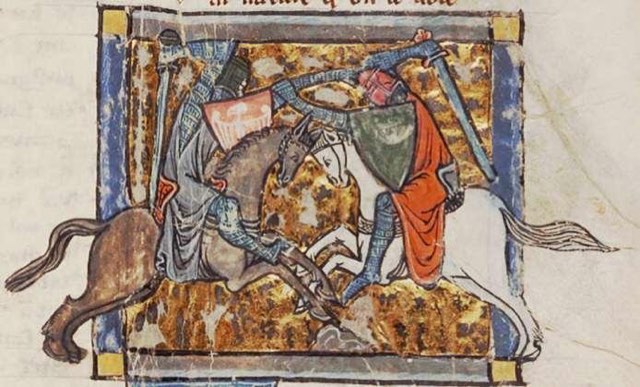

The Normans and Their Takeover of England
- 1066; Fordham University’s Internet Medieval History Sourcebook: William of Malmesbury’s The Battle of Hastings, 1066; Catholic Encyclopedia’s William the ConquerorThe ORB · Online Reference Book for Medieval Studies · Steven Muhlberger’s Medieval England · read · 2 h
Changes to the Social Structure: The New Aristocracy
- The Sundering of Society, 1350 - 1500 and Regia Anglorum Publication’s Norman Social Organization and FeudalismLynn Harry Nelson · read · 45 min
The Influence of the French Language and the Displacement of Old English
- Middle EnglishWashington State University · Dr. Michael Delahoyde · read · 30 min
- The Norman Conquest of EnglandWikipedia · read · 30 min
Changes to the English Language and Norman Rule from the English Perspective
- The Anglo-Saxon Chronicle and The ORB: Online Reference Book for Medieval Studies: Steven Muhlberger’s Medieval England: AlfredYale University · James Ingram’s version of · read · 3 h
The Breton Storyteller and Oral Traditions
- The Norman Settlement; Carson-Newman College: Dr. L. Kip Wheeler’s Map of Breton; The Middle Ages’ King ArthurThe ORB · Online Reference Book for Medieval Studies · Steven Muhlberger’s Medieval England · read · 1 h · archived copy
What Is a Lai? Matters of Form, Subject, and Audience in the New Genre
- Literary Terms and DefinitionsCarson-Newman College · Dr. L. Kip Wheeler · read
Marie de France’s Lanval and the Birth of the Romance Genre
- Marie de France’s ‘Lanval’ and the Birth of the Romance Genre; University of Florida: Judith P. Shoaf’s Translation of Marie de France’s The Lais of Marie de France: Lanval; Washington State University: Dr. Michael Delahoyde’s Romance; Carson-Newman College: Dr. L. Kip Wheeler’s Medieval RomanceThe Saylor Foundation · read · 4 h
Chretien de Troyes and the Invention of the Verse Romance
- King ArthurW.W. Norton and Company’s The Norton Anthology of English Literature · read · 15 min · archived copy
King Arthur’s Court, Celtic Origins, and the Figure of the Chivalric Knight in Romans d’Aventure
- Arthurian Romance and Courtly LoveWashington State University · Dr. Michael Delahoyde · read · 45 min
Chrétien de Troye’s “Yvain, le Chevalier au Lion,” the Class System, and Anglo-Norman Values
- Chrétien de Troye as well as Illustrations; The Saylor Foundation’s Chretien de Troye’s ‘Yvain, le Chevalier au Lion,’ the Class System, and Anglo Norman Values; Project Gutenberg: De Troye’s Yvain, le Chevalier au LionW.W. Norton and Company’s The Norton Anthology of English Literature · read · 10 h · archived copy
Geoffrey of Monmouth’s “The History of the Kings of Britain” and the Appeal of King Arthur’s Court
- The History of the Kings of Britain and Fordham University’s Internet Medieval History Sourcebook: Scott McLetchie’s Translation of Gerard of Wales’s The Discovery of the Tomb of King Arthur, from On the Instruction of a PrinceThe Camelot Project at the University of Rochester · J.A. Giles’s Translation of Geoffrey of Monmouth · read · 7 h · archived copy
Developments in Religious Communities in the Anglo-Norman Period
- The Church under the Normans; W.W. Norton and Company’s The Norton Anthology of English Literature: The First Crusade; Godfrey Daimbert and Raymond Daimbert’s Letter to the Pope (1099) and The Duke of Lorraine’s Letter to the Archbishop of Cologne (1197)The ORB · Online Reference Book for Medieval Studies · Steven Muhlberger’s Medieval England · read · 1 h · archived copy
The Influence of Romance Literature on Religious Writing
- Notes on Middle English RomanceUniversity of Central Arkansas · Dr. Jonathan A. Glenn · read · 30 min
“Ancrene Riwle” and the Knightly Figuration of Christ
- Ancrene Wisse and Hermitary’s ‘Ancrene Wisse’: A Medieval Guide for AnchoressesUniversity of Rochester · Robert Hasenfratz’s Edited version of · read · 12 h · archived copy
Chapter II
Middle English Literature
In this final unit, we will review the turbulent history of the late Medieval period, from England’s involvement in a number of wars to the outbreak of the bubonic plague in the 14thcentury. We will also chart the key social and cultural changes of the times: the rise of the merchant class, the linguistic transition from the French of the Anglo-Norman Period to Middle English, and the changing perspectives on the Church. With these contexts in mind, we will explore developments in the romance genre and study the many literary innovations of Geoffrey Chaucer and his Canterbury Tales, including his break from alliterative verse and his thematic attention to social dynamics and class relations. Finally, we will examine religious works written during this late period, including the mystical writings of anchoresses like Julian of Norwich and the growth of religiously-oriented drama as a popular genre.
In the Great Books lists The Canterbury Tales · Troilus and Criseyde
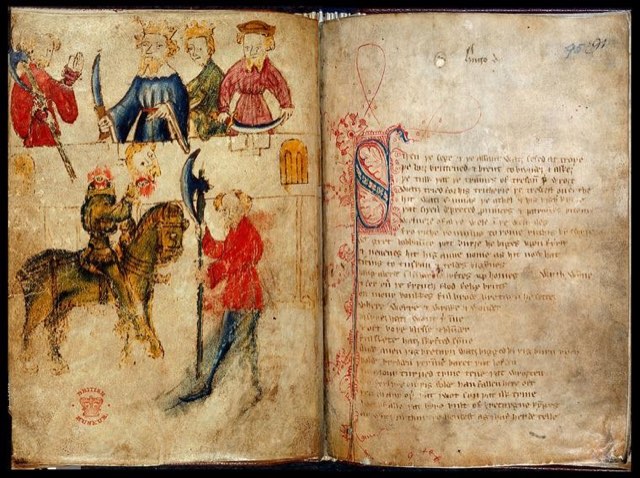

Tumultuous Politics and the Outbreak of War in the 14th and 15th Centuries
- Crusades and The ORB: Online Reference Book for Medieval Studies: Steven Muhlberger’s Medieval England: Origins of the Hundred Years’ War, Economic Change and Social Tension in the Late Fourteenth Century, and The Beginning of the Wars of the RosesCatholic Encyclopedia · read · 3 h
The Black Death
- The Great Famine and the Black Death and Brown University: Decameron Web’s Social and Economic Effects of the PlagueLynn Harry Nelson · read · 30 min
Class and Economics in the Late Medieval Period: Capitalism on the Rise
- The Rise of Capitalism and Decline of the GildsLynn Harry Nelson · read · 30 min
The Birth of Middle English
- Medieval* and Rice University: Suzanne Kemmer’s A Brief History of EnglishCarson-Newman College · Dr. L. Kip Wheeler’s * · read · 30 min
William Langland’s “Piers Plowman” and the Social and Religious Issues of the Day
- Piers Plowman and Harvard University’s The Geoffrey Chaucer Page: L.D. Benson’s William Langland: Piers PlowmanWilliam Langland · read · 10 h
The Alliterative Revival
- Literary Terms and Definitions: Alliterative Revival and Alliterative Verse; The Alliterative Morte ArthureCarson-Newman College · Dr. L. Kip Wheeler · read · 30 min
Magic and Supernatural Powers in the Romance Genre
- Literary Terms and Definitions: Medieval RomanceCarson-Newman College · Dr. L. Kip Wheeler · read
- Arthurian Literature and Its ThemesiTunes U · Montgomery Community College · Dr. Catherine Carsley · watch · 1 h · archived copy
Sir Gawayne and the Green Knight
- Sir Gawain and the Green KnightWikipedia · read · 30 min
- Sir Gawayne and the Green KnightRichard Morris’s Edited Version of · read · 4 h
- Arthurian Literature and Its ThemesiTunes U · Montgomery Community College · Dr. Catherine Carsley · watch · 1 h · archived copy
What Was Chaucer?
- The Life of Chaucer and Chronology of ChaucerHarvard University’s The Geoffrey Chaucer Page · L.D. Benson · read · 15 min · archived copy
Metrical Innovation - Chaucer’s New Narrative Style
- The High Style and Rice University: Suzanne Kemmer’s A Brief History of English: Middle English Period (c.a. 1100 - 1500)Harvard University’s The Geoffrey Chaucer Page · L.D. Benson · read · 15 min · archived copy
The Canterbury Tales: “The General Prologue”
- The General PrologueChaucer’s The Canterbury Tales · read · 3 h
- Irony and Character in Chaucer’s General PrologueiTunes U · Montgomery Community College · Dr. Catherine Carsley · watch · 1 h · no longer online
The Sound of Middle English: Audio Version of The Canterbury Tales and Exercises in Pronunciation
- Chaucer’s Pronunciation, Grammar, and VocabularyHarvard University · read · 1 h · archived copy
- The General PrologueW.W. Norton and Company’s The Norton Anthology of English Literature · Alfred David’s Reading of The Canterbury Tales · read · 15 min · archived copy
“The Miller’s Tale: The Prologue” and Conventions of Satire
- The Miller’s Tale: The Prologue and Carson-Newman College: Dr. L. Kip Wheeler’s Literary Terms and Definitions: Medieval Estates SatireChaucer’s The Canterbury Tales · read · 2 h
“The Wife of Bath’s Tale: The Prologue”: Feminism and Antifeminism
- The Wife of Bath’s Tale: The PrologueChaucer’s The Canterbury Tales · read · 5 h
- Authority and Experience in Chaucer’s ‘The Wife of Bath’s Tale’iTunes U · Montgomery Community College · Dr. Catherine Carsley · read · 1 h · no longer online
The Cycle Plays and Their Social Context
- The Medieval Drama and Robert Huntington Fletcher’s Medieval Drama: An Introduction to Middle English PlaysBrander Matthews’ · read · 2 h
“The Second Shepherds’ Play,” Social Commentary, and Religion
- A Field Guide to ‘The Second Shepherds’ Play’ and University of Michigan’s version of The Second Shepherds’ PlayFolger Shakespeare Library · read · 2 h · archived copy
The Morality Plays and the Birth of Professional Theater
- MoralitiesCatholic Encyclopedia · read · 30 min
Everyman and Thematic and Generic Conventions of Middle English Drama
- Introduction to Everyman ; EverymanAnniina Jokinen · read · 2 h
Dream Visions, Mysticism, and a New Understanding of the Relationship between Man and God
- Mysticism and Interpretation of DreamsCatholic Encyclopedia · read · 45 min
Women and the Church
- Directions of Change in Women’s Lives, 1200 - 1800 (Part 1)iTunes U · Arizona State University · Dr. Andrew Barnes · read · no longer online
Depictions of God and Changes in the Church
- To the Reader and Chapters 1 - 3 and 58 - 60; University of Rochester: Lynn Staley’s edited version of The Book of Margery Kempe: Book I; Virtual Library’s The Great SchismJulian of Norwich’s Revelations of Divine Love · read · 12 h
- Women’s Devotional Literature of the Middle AgesiTunes U · Montgomery County Community College · Dr. Catherine Carsley · read · 1 h · no longer online
- Depictions of God and Changes in the ChurchThe Saylor Foundation · read · 15 min
About this course
This course is Saylor Academy's ENGL201, Medieval English Literature and Culture, one of the complete university courses the Saylor Foundation made free from 2008 and retired in 2015. Saylor licensed its course text under CC BY 3.0; the original is on GitHub. Here it is laid out as chapters, links that have died go to an archived copy from the Internet Archive where one exists, assessments that needed a Saylor login are left out, and people and works are linked to Kulturbase. The readings and lectures belong to their publishers and are linked, not copied. Pictures: Wikimedia Commons, credited under each picture.
All Saylor courses · Free culture courses · The Chautauqua Reading Course