Literature · Saylor ENGL408
Modern Poetry and Poetics
The decades between roughly 1890 and 1960 witnessed unprecedented efforts to create new art, new values, and a new culture in Europe and the United States to distance itself from the more socially acceptable works of late Victorian poets and artists. During this time, Western writers, artists, and intellectuals questioned the accepted aesthetic norms and produced radically experimental works of art and new understandings of what it means to live in modern times.
More about this course
The first half of the 20th century also witnessed the most devastating conflicts in Western history – the two World Wars and the Holocaust – and these events accelerated and profoundly influenced cultural changes. Modernist poetry – one of the most interesting cultural developments – emerged during this time. While it is true that modernist poetic developments sprang up in unlikely and seemingly spontaneous ways, we will attempt to progress through this course in a roughly chronological manner. This is because, in many ways, even modern poetry retains a social form that can reflect the cultural and political situations in which it is written. The course starts with a theoretical consideration of modernity and modernism, as well as a brief introduction to poetics and some references to pre-modern Victorian poetic practices. This course then explores transitional, fin-de-siècle poetic innovations of the French symbolists and World War I poets. The course addresses early modernist movements like Imagism, Vorticism, and Futurism as well as the writings of High Modernism. A unit on African-American modernism, often referred to as the Harlem Renaissance, explores another crucial dimension. Finally, you will analyze how World War II and the Holocaust affected poetry. By the end of the course, you will have studied the work of major American and British modernist poets, and you will have critically explored the characteristic techniques, concerns, and tropes of modern poetry. The Course’s Grand Design Two Bridges to Modernity Think of this course in terms of two bridges. The shorter bridge is the main subject of this course, or modern poetry in a certain time period, being from the relative orderliness of the late 19th century (i.e., Victorian era) to the chaotic end of World War II and the potentialities for world-wide nuclear annihilation during the early 1960’s. The Longer Bridge The longer cultural bridge is the overarching philosophical paradigm shift to modernity, * marked in literary terms on one end by John Milton’s 1674 Paradise Lost [Note: The best website for all of Milton’s poetry is The John Milton Reading Roomat Dartmouth.] and on the other end by William Carlos Williams’ 1923 “The Red Wheelbarrow.” The really big question in this course is how did Western culture come from Milton’s confident “justifying the ways of God to men” in his epic poem: Of Man’s First Disobedience, and the Fruit Of that Forbidden Tree, whose mortal taste Brought Death into the World, and all our woe, With loss of Eden, till one greater Man Restore us, and regain the blissful Seat, Sing Heav’nly Muse, that on the secret top Of Oreb, or of Sinai, didst inspire That Shepherd, who first taught the chosen Seed, In the Beginning how the Heav’ns and Earth Rose out of Chaos: . . . to barely being able to hang on to the existence of reality itself with William Carlos Williams’ poem? so much depends upon a red wheel barrow glazed with rain water beside the white chickens “So much depends” on what, Mr. Williams? Milton explained in gargantuan detail what depended on Adam’s tasting of the forbidden fruit, while William Carlos Williams leaves us with a 16 word enigma about a wheelbarrow and chickens. The Shorter Bridge The shorter bridge that this course on the modern represents is the one that connects the Victorian period to the start of our contemporary ** artistic endeavors. The one that begins near Tennyson’s “Into the valley of death rode the 6,000” and ends with the advent of the Beat poets with Ginsberg’s “Howl”: “dragging themselves through the negro streets at dawn looking for an angry fix.” Ginsberg’s “Howl” in so many ways registers the culmination of the wars and the beginning of self-absorbed, contemporary poetry, which would be the subject for a subsequent course. The main goal of this course is to show you the functioning of that shorter bridge. Hart Crane visualized it both concretely and metaphorically. For him, it was the “Brooklyn Bridge” itself. For me, it is the term modern. On her death bed, Gertrude Stein’s last words expressed modern art’s *** continuing efforts to express the inexpressible in our center-less universe. “What is the answer?” she asked, and when no answer came she laughed and said: “Then, what is the question?” We will hear a number of 20th century poets try to explore these questions throughout this course.
Upon successful completion of this course, you should be able to:
In order to take this course, you must:
Chapter I
The Province of Modern Poetry
This course will attempt to snake its way chronologically through the poetry produced in the first half of the 20th century under the literary banner of modernism. In Unit 1, we will begin by defining modernism and reviewing the poetry and poets that preceded modern poetry in the Victorian era. With the objective of defining modernism in mind, we will explore what modern is NOT – that is, you will explore those 19th-century assumptions and conventions that modern poets sought to dissociate themselves from and the socio-historical context in which they had developed. This unit contains a sampler of the Victorian-era establishment-approved poets – Alfred, Lord Tennyson, Rudyard Kipling, Matthew Arnold, Henry Wadsworth Longfellow, and John Greenleaf Whittier – that the modernist poets so self-consciously rebelled against. The modernist poets also rebelled against those societies that produced World War I, World War II, and the Cold War. Fortunately, the most familiar American poet, Robert Frost, emerged at the beginning of the modernist movement. Frost is the poet that Professor Langdon Hammer first chooses to introduce in his “Modern Poetry” course at Yale University. The unit will lead into an introduction of modern poets through a study of Robert Frost. Finally, this unit will conclude with a general discussion of characteristic modernist concerns as they tend to be defined by scholars.
In the Great Books lists North of Boston
Modernism: Historical Background and Preliminary Definitions
- The Roots of ModernismSweet Briar College · Dr. Christopher L.C.E. Witcombe · read · 1 h · archived copy
- Make It New: The Rise of Modernism ExhibitionThe University of Texas at Austin · Harry Ransom Center’s Press Release · read · 15 min
Differentiating Our Modernist Terminology
- Modernism, Modernization, Modernité, Modern: Some DefinitionsVanderbilt University · Dr. Bill Kupinse · read · 15 min · archived copy
Alfred, Lord Tennyson
- The Charge of the Light BrigadeVictorian Web · Alfred Lord Tennyson · read · 30 min
- Explication CommentaryVictorian Web · Hamilton Beck · read · 15 min
- ‘The Brook,’ ‘Break, Break, Break,’ ‘Sweet and Low,’ and ‘The Eagle’Internet Archive · Alfred Lord Tennyson · read · 1 h
Rudyard Kipling
- My Father’s Chair, The Secret of the Machines, A Song of the English, and Alastair Wilson’s Commentary on ‘A Song of the English’Rudyard Kipling · read · 1 h · archived copyRudyard Kipling on Kulturbase
Matthew Arnold
- Dover BeachVictorian Web · Matthew Arnold · read · 30 min
- Arnold’s ‘Dover Beach’: A CommentaryVictorian Web · Julia Touche · read · 15 min
Henry Wadsworth Longfellow
- An April DayPoem Hunter · Henry Wadsworth Longfellow · read · 30 min
- The Landlord’s Tale: Paul Revere’s RideUniversity of Toronto’s Representative Poetry Online · Henry Wadsworth Longfellow · read · 45 min
- How Longfellow Woke the DeadThe American Scholar · Jill Lepore · read · 1 h
John Greenleaf Whittier
- Biography of John Greenleaf WhittierNNDB · read · 30 min
- Telling the BeesNorth Shore Community College · John Greenleaf Whittier · read · 30 min · archived copy
- Poem of the Week: ‘Telling the Bees’ by John Greenleaf WhittierThe Guardian · Carol Rumens’ · read · 30 min
Introduction to Modern Poetry and Robert Frost
- Lecture 1: Introduction to Modern PoetryYale University · Professor Langdon Hammer · watch · 1 h
- Out, Out and MowingPoem Hunter · Robert Frost · read · 45 min
- Lecture 2: Robert FrostYale University · Professor Langdon Hammer · watch · 1 h
- Unit 1 AssessmentThe Saylor Foundation · write · 3 h
Chapter II
The French Symbolists: The Fountainhead of Modernism
Now that you have a good sense of the conventions and assumptions that the modernists resisted, we will turn our attention to the French Symbolists in this unit. *By studying the material in this unit, you will be able to answer questions about the relationship between Anglo-American modern poetry of the 20th century and the French Symbolist poetry of the 19th century. You will be able to distinguish the avant-garde poetic experiments of three of the best known poets of this movement: Charles Baudelaire, Arthur Rimbaud, and Stéphane Mallarmé. You will also be able to recognize how those experiments became the fountainhead of modernism.
In the Great Books lists Les Fleurs du mal
Concepts of Truth and Elements of Mystery in French Symbolist Poetry
- A Brief Guide to the SymbolistsPoets.org · The Academy of American Poets’ · read · 1 h
Charles Baudelaire, Father of Modern Poetry
- Correspondences, Invitation to a Voyage, and CatsPoem Hunter · Charles Baudelaire · read · 1 h
Arthur Rimbaud, Stéphane Mallarmé, and the French Symbolists
- Dawn, Departure, Eternity, and SleepBlack Cat Poems · Arthur Rimbaud · read · 2 h
- Afternoon of a FaunAngelfire · Stéphane Mallarmé · read · 30 min · archived copy
- Unit 2 AssessmentThe Saylor Foundation · write · 3 h
Chapter III
Early Modernist Movements: Symbolism, Imagism, and Their Relatives
From a contemporary poet’s perspective that often simplifies the initial choice of directions between formalist verse such as Dylan Thomas’ famous villanelle “Do not go gentle into that good night” and free verse such as e.e. cummings’ “spring is like a perhaps / Hand in a window,” the existence of so many, often contentious movements, in modern poetry (1900–1960) seems peculiar. What may be even stranger is that almost every movement is backed by a revolutionary manifesto, arguing that movement’s greater understanding of the true nature or purpose of its brand of poetry, published in its own special journal. Jeanine Johnson in her book, Why Write Poetry?: Modern Poets Defending Their Art, attempts to sum up the rationale behind the plethora of poetic movements that sprung up throughout the 20th century:
The Decadent Symbolists
- Poetic Modes in the Late 19th and Early 20th CenturyGrand Valley State University · Michael Webster · read · 1 h
William Butler Yeats and the Early Use of Irish Mythology
- The Song of Wandering Aengus and A CoatPoetry Foundation · William Butler Yeats’ · read · 1 hWilliam Butler Yeats on Kulturbase
- The Madness of King GollWikiSource · William Butler Yeats’ · read · 2 hWilliam Butler Yeats on Kulturbase
- Lecture 4: William Butler YeatsYale University · Professor Langdon Hammer · watch · 2 hWilliam Butler Yeats on Kulturbase
- To the Rose upon the Rood of TimePoetry Archive · William Butler Yeats’ · read · 30 min · archived copyWilliam Butler Yeats on Kulturbase
- The Wild Swans at CoolePoetry Foundation · William Butler Yeats’ · read · 30 minWilliam Butler Yeats on Kulturbase
- The Symbolism of PoetryWilliam Butler Yeats’ · read · 2 h · archived copyWilliam Butler Yeats on Kulturbase
Wallace Stevens as an American Symbolist
- Sunday Morning and The Man on the DumpPoem Hunter · Wallace Stevens’ · read · 2 h
- Lecture 19: Wallace StevensYale University · Professor Langdon Hammer · watch · 1 h
- Thirteen Ways of Looking at a BlackbirdUniversity of Pennsylvania · Wallace Stevens’ · read · 30 min
What Is Imagism?
- ImagismUniversity of Pennsylvania · Dr. Al Filreis’ · read
- ImagismWikipedia · read · 30 min
- Lecture 8: ImagismYale University · Professor Langdon Hammer · watch · 1 h
Ezra Pound’s Early Experiments with Symbolism and Imagism
- Biography of Ezra PoundThe Poetry Foundation · read · 45 min
- A Few Don’ts by an ImagisteThe Poetry Foundation · Ezra Pound · read · 1 h · archived copy
- In a Station of the Metro and The River-Merchant’s Wife: A LetterPoetry Foundation · Ezra Pound · read · 1 h
H.D.’s Imagist Poems
- Sea RoseUniversity of Pennsylvania · H.D. · read · 30 min
- OreadPoetry Foundation · H.D. · read · 15 min
Amy Lowell’s Imagism and Amygism
- On ImagismModern American Poetry · Amy Lowell · read · 45 min · archived copy
- The Green Bowl and PatternsAmerican Poems · Amy Lowell · read · 1 h
Marianne Moore: The Grand Promoter
- Marianne MooreWikipedia · read · 15 min
- A Grave, An Octopus, Silence, The Fish, and The Paper NautilusPoem Hunter · Marianne Moore · read · 3 h
- Lecture 17: Marianne Moore and Lecture 18: Marianne Moore (cont.)Yale University · Professor Langdon Hammer · watch · 3 h
William Carlos Williams: Movement and Stasis
- Biography of William Carlos WilliamsThe Poetry Foundation · read · 45 min
- Lecture 16: William Carlos WilliamsYale University · Professor Langdon Hammer · watch · 1 h
- The Poem as a Field of ActionWilliam Carlos Williams’ · read · 2 h · archived copy
- The Red WheelbarrowUniversity of Pennsylvania · William Carlos Williams’ · read · 15 min
- This Is Just to SayPoets.org · William Carlos Williams’ · read · 15 min
- Unit 3 AssessmentThe Saylor Foundation · write · 3 h
Chapter IV
Poetry of World War I and Its Aftermath
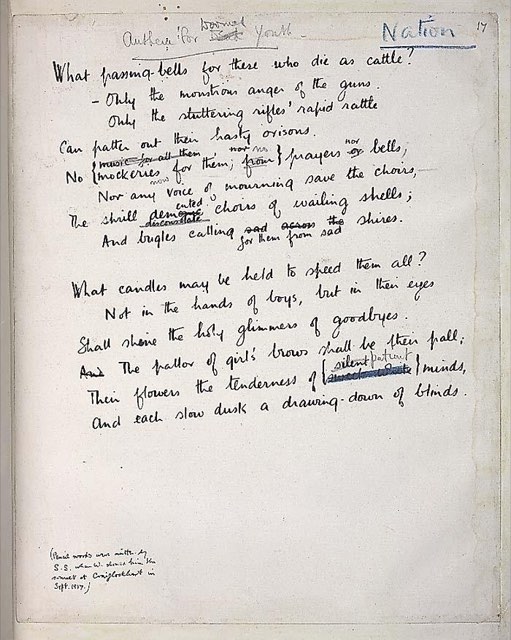
While poets experimented with new poetic forms and styles, Europe was consumed by war. In this unit, you will chart the progression of attitudes toward the war as expressed through poetry, beginning with the patriotic verses of the early war years and continuing through some of the bitterer, disillusioned lyrical poems of the late war years. You will study changes in form, tone, and style, all the while noting the degree to which the war’s major poets adhered to traditional (19th-century) conventions and hypothesizing reasons for that allegiance despite the explosion of avant-garde trends. In this unit, you will study poems by Siegfried Sassoon, Rupert Brooke, Wilfred Owen, Rudyard Kipling, and e.e. cummings.

Off to War – the Chivalric Ideal
- The Dragon and the UndyingVoices Education · Siegfried Sassoon · read · 30 min · archived copy
- The SoldierRupert Brooke · read · 1 h
Realities of Modern Warfare
- The Western Front and the Birth of Total War, Dr. Joanna Bourke’s Shell Shock during World War One, and Dr. Ruth Henig’s Versailles and PeacemakingBBC · Dr. Stephen Badsey · read · 2 h
The Great War and Poetry: Reflection, Disillusionment, and Bitter Critique
- Biography of Wilfred Owen, Biography of Thomas Hardy, Biography of Siegfried Sassoon, and Biography of Isaac RosenbergThe Poetry Foundation · read · 2 h
- Lecture 7: World War I Poetry in EnglandYale University · Professor Langdon Hammer · watch · 2 h
Siegfried Sassoon
- Repression of War Experience and The Rear-GuardSiegfried Sassoon · read · 1 h
- On Passing the New Menin GateAftermathWWI.com · Siegfried Sassoon · read · 30 min · archived copy
Wilfred Owens
- Arms and the Boy, Anthem for Doomed Youth, and Dulce et Decorum EstThe Poetry Foundation · Wilfred Owens’ · read · 1 h
John McCrae
- In Flanders FieldsJohn McCrae · read · 30 min
Rudyard Kipling’s Change of Heart
- Epitaphs of the WarWeb-Books.com · Rudyard Kipling · read · 30 min · archived copyRudyard Kipling on Kulturbase
- Rudyard Kipling – Author, Poet, and Quintessential EnglishmanGreat War Literature Magazine · W. Lawrance · read · 45 min · archived copyRudyard Kipling on Kulturbase
e.e. cummings
- i sing of Olaf glad and bigPoets.org · e.e. cummings’ · read · 45 min
- next to of course god america IThe Literature of Poetry · e.e. cummings’ · read · 45 min
- The Rebellion of E.E. CummingsHarvard Magazine · Adam Kirsch · read · 45 min
Post-War Georgian Poetry and the Emergence of Modernist Poetry
- The TruantsPoetry X · Walter de la Mare · read · 30 min
- The Georgian Poets and the War PoetsLiterature Study Online · Stephen Colbourn · read · 2 h
- Unit 4 AssessmentThe Saylor Foundation · write · 3 h
Chapter V
Other Modernist Movements: Futurism, Vorticism, and Objectivism
In this unit, you will study a sampling of the manifestos behind the poetry of three competing poetic movements from the 1910s to 1930s: Futurism, Vorticism, and Objectivism. This unit will work to define and characterize these movements. Futurism, often associated with Marinetti’s Manifesto of Futurism, was an artistic and social movement that aimed to reject traditional forms of art (i.e., for poetry, rejecting the rules that govern prosody) and focused on imagery as well as precision. Futurist poets highlighted concepts of the future and developed a new language with the play of syntax and alternative substitutions for meter, in the traditional sense. Vorticism, first introduced by Pound’s essay “Vortex” in BLAST, was inspired by Cubism as well as embraced the focus on the mechanical age presented in Futurism. Vorticism focused on abstraction and typographical exploration, and it aimed to capture movement and stillness within an image. In 1930, Objectivism was coined by William Carlos Williams; in consideration of writing, he described this as having “a special eye to its structural aspects, how it has been constructed.…” This concept was expanded on by Louis Zukofsky, who reluctantly pioneered Objectivism at Harriet Monroe’s request to give a name to his associated group of poets. In response to Monroe, Zukofsky said, “No, some of us are writing to say things simply so that they will affect us as new again.” The Objectivist agenda, as defined by Zukofsky, aimed for simplicity and clarity, attempted to create something new, and treated a poem as an object. As you study the material in this unit, consider how these movements compare and contrast to the rhetorical aim of Imagism.
What Is Futurism?
- Chapter 1: Futurist VelocitiesPrinceton University Press · Christine Poggi’s Inventing Futurism · The Art and Politics of Artificial Optimism · read · 2 h · archived copy
- Aphorisms on Futurism, Lunar Baedeker, and Giovanni FranchiThe Poetry Foundation · Mina Loy · read · 3 h · archived copy
Italian Futurism
- Italian Futurismwendtroot.com · read · 15 min · archived copy
- Filippo Marinetti’s Excerpts from Manifesto of FuturismUniversity of Pennsylvania · read · 1 h · archived copy
Russian Futurism
- A Brief Guide to Futurism and Biography of Vladimir MayakovskyPoets.org · read · 45 min
Futurism and Fascism
- Futurism and FascismHistory Today · Richard Jensen · read · 1 h · archived copy
Introduction to Vorticism
- Introduction [to Vorticism] and Modern VorticistsVorticism · read · 15 min · archived copy
Pound’s “Vortex”
- VortexThe Poetry Foundation · Ezra Pound · read · 30 min · archived copy
Wyndham Lewis and the Vortex Manifesto
- Biography of Wyndham LewisVorticism · read · 15 min · archived copy
- Long Live the Vortex! and Our VortexThe Poetry Foundation · Wyndham Lewis’ · read · 30 min · archived copy
- BLAST (No. 1, Ed. Wyndham Lewis)Brown University and The University of Tulsa’s The Modernist Journals Project · read · 3 h
What Is Objectivism?
- The Energies of WordsThe Poetry Foundation · Peter O’Leary · read · 1 h
- Poetry, February 1931The Poetry Foundation · read · 2 h · archived copy
- Discussion at the Kelly Writers House, Moderated by Bob PerelmanUniversity of Pennsylvania’s PennSound · watch · 1 h
- Unit 5 AssessmentThe Saylor Foundation · write · 3 h
Chapter VI
High Modernism
The literary aesthetic of High Modernism, which represented the ways modernity was transforming culture by experimenting with, adapting, and altering more traditional literary styles and forms, is best understood as a profound ambivalence about both the present and the past. Modernist poets tended toward fragmented and disjointed perspectives rather than cohesive or coherent patterns in order to question rather than explain and to reject the illusive order of literary artifice in a world of relative truth rather than objective truth. Their poetic expressions at times appear to be the free associations. A work like Eliot’s Waste Land includes overarching patterns and echoing classical or mythic narratives, but the allusions are foregrounded by very personal and opaque commentary or by snapshots of interruptive images as if a bomb had exploded a church’s stained glass window onto a city’s dump-site. The high modernist emphasis on individual experience over objective truth ironically also meant incorporating elements of popular culture, which had not been thought literary enough for high art until then, mixing in colloquialisms and dialects without the aid of an interpretive narrator. Pub diction and Dante Italian and Sanskrit swirl in word searches for the holy grail of meaning in desiccated land and cityscapes. The demands of high modernist style tapping into precious and arcane cultural allusion without context or even perceived intention guaranteed a small, very educated elite readership and fed an army of academic explicators. Then again, less obtuse and far more commercially successful poets like Frost and Sandburg were viewed as sell-outs to bourgeois culture. Probably the greatest irony of the high modernist poets was that the more that they protested how new they were their use of highly traditional, even ancient, poetic forms grew. Ezra Pound’s later work providing the most obvious exemplars. This ambivalence may be best encapsulated by the title of T. S. Eliot’s influential essay “Tradition and the Individual Talent” and such mind-twisting statements as “No poet, no artist of any art, has his complete meaning alone. His significance, his appreciation is the appreciation of his relation to dead poets and artists.” How that jives with Pound’s modernist mantra, “Make it new,” is the conundrum of these poets and their critics. Hart Crane’s “The Bridge” is probably the best example of this high modernist merging of a deep, almost impenetrable, subjectivity with the traditional epic form.
In the Great Books lists The Waste Land
Make It New: The Complicated Relationship between High Modernism and Earlier Texts
- Lecture 9: Ezra PoundYale University · Professor Langdon Hammer · watch · 1 h
Pound’s Return of the Epic Form in Modern Poetry
- Canto XIVPoets.org · Ezra Pound’s The Cantos · read
Eliot’s Tradition and the Individual Talent
- Tradition and Individual TalentPoetry Foundation · T.S. Eliot · read · 1 h · archived copyT.S. Eliot on Kulturbase
The Artist in Exile: Ezra Pound’s Hugh Selwyn Mauberley
- Excerpts from Pound’s Hugh Selwyn MauberleyModern American Poetry · read · 1 h · archived copy
The American Expatriates in Europe
- Biography of Gertrude Stein and Biography of H.D.The Poetry Foundation · read · 1 h
- Literary Expatriates in ParisUniversity of North Carolina at Chapel Hill Library · read · 30 min · archived copy
- A Carafe, That Is a Blind Glass, A Little Called Pauline, and NewThe Poetry Foundation · Gertrude Stein · read · 45 min
William Butler Yeats: The Mature Years
- Easter, 1916 and The Second ComingThe Literature Network · William Butler Yeats’ · read · 1 h · archived copyWilliam Butler Yeats on Kulturbase
- Lecture 5: William Butler Yeats (cont.)Yale University · Professor Langdon Hammer · watch · 1 hWilliam Butler Yeats on Kulturbase
A Heap of Broken Images: The Modern World as Waste Land
- Lecture 10: T.S. Eliot, Lecture 11: T.S. Eliot (cont.), and Lecture 12: T.S. Eliot (cont.)Yale University · Professor Langdon Hammer · watch · 4 hT.S. Eliot on Kulturbase
- T.S. Eliot’s The Waste LandProject Gutenberg · read · 5 h · archived copyT.S. Eliot on Kulturbase
Hart Crane
- Biography of Hart Crane, Hart Crane’s Legend, and Selections from Hart Crane’s The BridgeThe Poetry Foundation · read · 2 h
- Hart Crane: VoyagesThe Poetry Foundation · Brian Reed · read · 1 h
- Lecture 13: Hart Crane and Lecture 14: Hart Crane, (cont.)Yale University · Professor Langdon Hammer · watch · 2 h
- Unit 6 AssessmentThe Saylor Foundation · write · 3 h
Chapter VII
Politics and the Harlem Renaissance
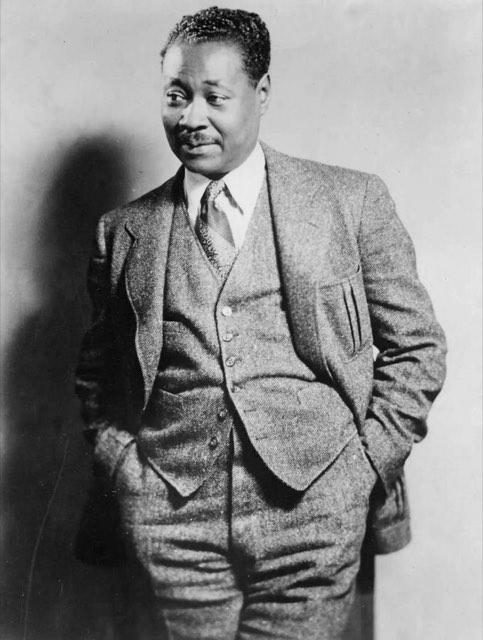
African American modernism, often referred to as the Harlem Renaissance, is crucial to the history of modernist poetry. Starting in the 1920s and 30s, Harlem Renaissance poets like Langston Hughes, Countee Cullen, and Jessie Redmon Fauset wrote poems that explored the African American experience and the challenges of modernity. Poems from the Harlem Renaissance showed concerns with grief, populist ideas, and pride and celebration of African American heritage and culture. The poems focused on intellectualism, explored free verse, and aimed to strengthen the voice of the speaker. In later years, writers like Gwendolyn Brooks, Margaret Walker, and Robert Hayden created new poetic forms in dialogue with both the Harlem Renaissance and broader developments in American and African American culture. In this unit, you will explore African American modernist poetry, and you will analyze its development, its unique features, and how these poems achieved (or attempted to achieve) certain political aims. As you study the poets and poems in this unit, consider how the themes and poetic devices used during the Harlem Renaissance fit into the modernist idea of making something new. Also, consider how culture and politics transformed the movement.

The Harlem Renaissance
- A Brief Guide to the Harlem RenaissancePoets.org · read · 15 min
- Harlem Renaissance: Pivotal Period in the Development of Afro-American CultureYale New Haven Teachers Institute · Caroline Jackson · read · 45 min · archived copy
- The Harlem Renaissance Multimedia ResourceJohn Carroll University · watch · 2 h · archived copy
W.E.B. Dubois’ “The Strivings of Negro People”
- The Strivings of Negro PeopleThe University of Virginia · W.E.B. Du Bois’ · read · 1 h · archived copy
James Weldon Johnson
- PrefaceJames Weldon Johnson (ed.)’s The Book of American Negro Poetry · read · 3 h · archived copy
Claude McKay
- Biography of Claude McKayThe Poetry Foundation · read · 30 min
- If We Must Die and The Harlem DancerClaude McKay · read · 30 min
Countee Cullen
- Biography of Countee CullenThe Poetry Foundation · read · 30 min
- A Brown Girl Dead, Heritage, and For Amy LowellThe Poetry Foundation · Countee Cullen · read · 2 h
Langston Hughes
- Biography of Langston HughesThe Poetry Foundation · read · 30 min
- Lecture 15: Langston HughesYale University · Professor Langdon Hammer · watch · 1 h
- The Negro Artist and the Racial MountainThe Poetry Foundation · Langston Hughes’ · read · 45 min · archived copy
- The Black Poet as Canon-MakerThe Poetry Foundation · Elizabeth Alexander · read · 30 min
- Ku KluxYouTube · Langston Hughes’ · watch · 15 min
- On ‘Ku Klux’Modern American Poetry · Onwucheka Jemie, Bartholomew Brinkman, and John Moore · read · 45 min · archived copy
- Langston Hughes in the 1930sModern American Poetry · James Smethurst · read · 30 min · archived copy
Cultural Challenges of Three African-American Women Poets
- Double-Bind: Three Women of the Harlem RenaissancePoets.org · Anthony Walton · read · 45 min
Jesse Redmon Fauset
- Dead Fires and La Vie C’est La ViePoets.org · Jesse Redmon Fauset · read · 30 min
Georgia Douglas Johnson
- Common Dust and Smothered FiresThe Poetry Foundation · Georgia Douglas Johnson · read · 30 min
- Black Woman and The Heart of a WomanPoet.org · Georgia Douglas Johnson · read · 30 min
Gwendolyn Bennett
- Quatrains, Fantasy, Sonnet 1, and Sonnet 2Poets.org · Gwendolyn Bennett · read · 1 h
- Unit 7 AssessmentThe Saylor Foundation · write · 3 h
Chapter VIII
Poetic Responses to World War II, the Holocaust, and the Global Nuclear Threat
In this unit, you will take a look at World War II poetry, keeping in mind the representation of war and violence we encountered in the World War I poems so as to compare and contrast these eras of poetry and the approach to the war poem. Consider whether the WWII poems more accurately address the realities of war. The question to consider in this unit and one that modernist poets toward the end of the movement sought to address is: *“Are the horrors of the World Wars, multiple genocides, and threat of nuclear incineration of cities and potentially the entire planet so monumental that they can only become trivialized by being spoken about as expository narrative or re-interpreted as art?”
The Holocaust: Representing the Unrepresentable
- ‘After the End of the World’: Poetry and the HolocaustMichigan Quarterly Review · Jay Ladin · read · 3 h · archived copy
- Holocaust Poetry: Another ViewMichigan Quarterly Review · Alicia Ostriker · read · 1 h
- Charles Reznikoff Reads from HolocaustThe University of Pennsylvania’s PennSound · watch · 45 min
Overview of the Japanese-American Internment Camps
- Executive Order 9066: The President Authorizes Japanese RelocationGeorge Mason University’s History Matters · read · 15 min · archived copy
- Letters from the Japanese American InternmentSmithsonian Center for Education and Museum Studies · read · 45 min
Wartime Kaikos (Free-Style Haikus)
- Pre-War Japanese American HaikuModern American Poetry · Violet Kazue de Cristoforo · read · 45 min · archived copy
- Poetry in History: Japanese American InternmentLantern Review Blog · read · 15 min
- Violet Kazue de CristoforoVoices [Education Project] · World War II Poets · read · 15 min · archived copy
- Haiku Poet Documented Life in Japanese CampsNPR · Sasha Khokha · watch · 30 min
Randall Jarrell
- The Death of the Ball Turret GunnerWestern Michigan University · Randall Jarrell · read · 30 min · archived copy
- The RefugeesModern American Poetry · Randall Jarrell · read · 30 min · archived copy
Keith Douglas
- Keith DouglasVoices [Education Project] · The Poets of World War II · read · 1 h · archived copy
Karl Shapiro
- Karl ShapiroVoices [Education Project] · The Poets of World War II · read · 1 h · archived copy
The Atom Bomb and Its Impact on Culture
- The Atomic Bomb in American CultureThe Christian Science Monitor · Jim Regan · read · 30 min
- Cultural Aspects of Atomic AnxietyUniversity of Pennsylvania · Professor Al Filreis’ · read · 1 h
- August 6, 1945The Peace Pledge Project · Alison Fell · read · 30 min · archived copy
- Talk in the DarkThe Peace Pledge Project · Denise Levertov · read · 1 h · archived copy
- Unit 8 AssessmentThe Saylor Foundation · write · 3 h
- ENGL408 Final ExamThe Saylor Foundation · final exam · no longer online
About this course
This course is Saylor Academy's ENGL408, Modern Poetry and Poetics, one of the complete university courses the Saylor Foundation made free from 2008 and retired in 2015. Saylor licensed its course text under CC BY 3.0; the original is on GitHub. Here it is laid out as chapters, links that have died go to an archived copy from the Internet Archive where one exists, assessments that needed a Saylor login are left out, and people and works are linked to Kulturbase. The readings and lectures belong to their publishers and are linked, not copied. Pictures: Wikimedia Commons, credited under each picture.
All Saylor courses · Free culture courses · The Chautauqua Reading Course