History · Saylor HIST313
War and American Society
This course will focus on the wars and military conflicts that have shaped the social, political, and economic development of the United States from the colonial era through the present. You will learn how these conflicts have led to significant changes in America social and political life during this 300-year period.
More about this course
The course will be structured chronologically. Each unit will include representative primary-source documents that illustrate important overarching themes, such as how colonial conflicts in the 18th century shaped the political organization of the United States, how regional conflicts in the 19th century culminated in the Civil War, how America cemented its status as a major world power through participation in the First and Second World Wars, how Cold War conflicts destabilized American social and political life, and how modern conflicts continue to redefine American social and political values and ideals. By the end of the course, you will understand how three centuries of warfare have reshaped America’s relationship with the world and altered American society in unexpected ways.
Upon successful completion of this course, the student will be able to:
In order to take this course you must: √ Have access to a computer. √ Have continuous broadband Internet access. √ Have the ability/permission to install plug-ins or software (e.g., Adobe Reader or Flash). √ Have the ability to download and save files and documents to a computer. √ Have the ability to open Microsoft files and documents (.doc, .ppt, .xls, etc.). √ Be competent in the English language. Table of Contents: You can find the course’s units at the links below.
Chapter I
War and the Founding of the United States
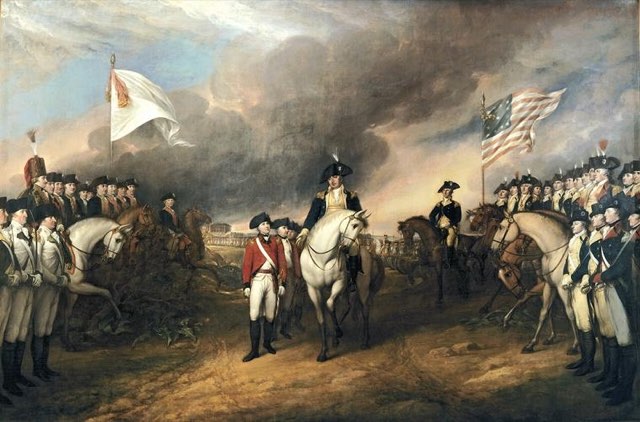
European military conflicts throughout the 18th century contributed to the formation of the United States in the 1780s. British, French, and Spanish forces fought incessantly throughout this period and American colonists were often caught in the middle of these global conflicts. Great Britain’s costly victory in the French and Indian War in 1763 led to higher taxes on American colonists, which generated social and political turmoil throughout the colonies. A decade later, frustrated American colonists challenged British political rule directly and eventually secured independence from the mother country after a lengthy military struggle. In this unit, we will examine how the French and Indian War and the American Revolution forged unique social and political values in the early United States. We will also look at how these conflicts shaped American cultural identities and redefined the relationship between civilian and military leaders in the New Republic.

The French and Indian War, 1754-1763
- Crucible of War: The Seven Years’ WarC-SPAN Video Library/Tattered Cover Bookstore · Fred Anderson · watch · no longer online
The American Revolution, 1776-1783
- American RevolutionWikibooks · U.S. History · read
- The Western Tradition: Lecture 37: The American RevolutionThe Annenberg Foundation and WGBH Boston · Eugen Weber · watch · archived copy
- The Reluctant Revolutionaries, Blows Must Decide, The Times that Try Men’s Souls, Oh, Fatal Ambition, The World Turned Upside Down, Are We To Be A Nation?Google Videos and vodpod’s · PBS’s Liberty! The American Revolution · watch · archived copy
- Colonial and Revolutionary America: Lecture 15: The Crisis of IndependenceiTunes U · Stanford University · Jack Rakove · watch
- Life Portrait of George WashingtonC-SPAN Video Library · American Presidents · watch
Rebels Versus Loyalists
- The Crisis No. 1 (December 23, 1776)Liberty Online’s version of Thomas Paine · read · archived copy
Civil War in the Colonies
- Colonial and Revolutionary America: Lecture 14: The View from LondoniTunes U · Stanford University · Jack Rakove · watch
Shays’ Rebellion
- Shays’ RebellionWikipedia · read
The Whiskey Rebellion
- The Whiskey RebellionWikipedia · read
Chapter II
1812 - The Second War for American Independence
The American Revolution secured American political independence from Great Britain, and a generation later, the War of 1812 reaffirmed that the young nation would remain free from British imperial domination and continue to assert its rights as an independent country. Americans objected to British mistreatment of American ships and sailors, as well as Britain’s continued economic and political support of militant Indian tribes throughout the Old Northwest. The war was not universally popular in the United States; during the middle of the conflict, some New Englanders even threatened secession if the conflict continued. The conflict tested America’s young military and highlighted the weaknesses of its volunteer militia forces. It also demonstrated the importance of a strong navy, since Great Britain effectively blockaded much of the American coast during the war and used ship-borne troops to capture Washington, D.C. and threaten Baltimore. The war ended in late 1814 with a negotiated peace treaty that maintained the status quo ante bellum, but Andrew Jackson’s surprising victory in early 1815 against British regulars at the Battle of New Orleans restored American pride in her military abilities and national strength. In this unit, we will focus on the origins of the conflict and examine how each side pursued wartime objectives. We will also examine the social impact of the War of 1812 on the American people and look at the lessons it offered American military leaders for generations to come.
The European Context
- Napoleon Bonaparte and the Rise of Nationalism & The Age of RevolutionsWikibooks · European History · read
French Revolution
- French Revolution (Part I)Khan Academy · watch
- French Revolution (Part 2)Khan Academy · watch
- French Revolution (Part 3) –Reign of TerrorKhan Academy · watch
Rise of Napoleon
- French Revolution (Part 4)—The Rise of Napoleon BonaparteKhan Academy · watch
Privateering and Naval Actions
- An Act to Encourage the Destruction of Armed Vessels of War of the Enemy March 3, 1813Yale Law School · Lillian Goldman Law Library · The Avalon Project · read
Chapter III
War and Westward Expansion
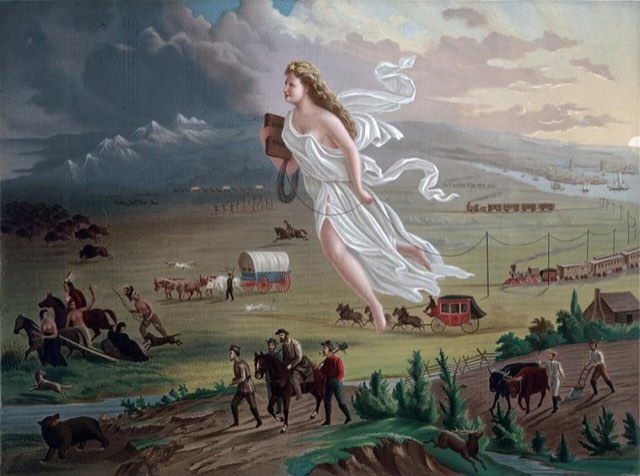
American settlers’ incessant westward expansion across the North American continent brought the United States into conflict with Native American inhabitants as well as the Mexican government during the first half of the 19th century. Indian wars were as old as the American colonies themselves, but they took on a particular intensity in the 19th century as the American government attempted to open up large sections of land in the trans-Appalachian frontier for American settlement. The American Army and volunteer militia forces relentlessly pursued Indian warriors and ruthlessly destroyed native villages and crops in an effort to wipe out all resistance. By the 1850s, most native tribes east of the Mississippi had been relocated to small reservation sites.

The Mexican War, 1846-1848
- The US-Mexican WarPBS · read · archived copy
- Life Portrait of James K. PolkC-SPAN, American Presidents · watch
Conclusion of the Conflict
- The Treaty of Guadaloupe Hidalgo February 2, 1848Fordham University’s The Modern History Sourcebook · Paul Halsall’s version of · read
Popular Sovereignty in Kansas
- Popular SovereigntyWikipedia · read
- Bleeding KansasWikipedia · read
Chapter IV
Brother Against Brother - The American Civil War
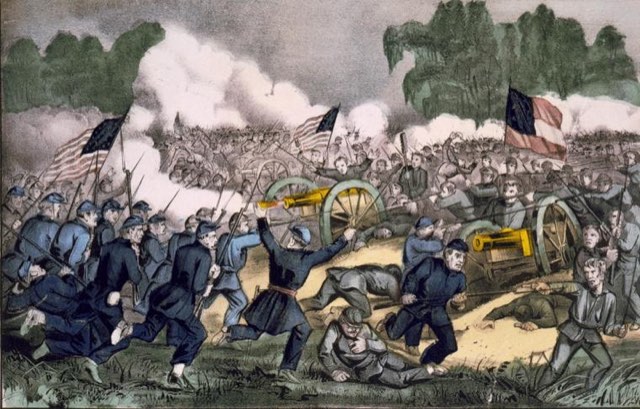
In 1861, social and political tensions that had been growing since the founding of the American Republic finally boiled over. Southern leaders feared that the federal government would attempt to regulate slave owning as a precursor to an outright ban on the practice. Advocates of states’ rights used Republican Abraham Lincoln’s 1860 election as grounds for secession from the Union. Just as secession tore the nation apart, it also splintered America’s military forces. Many southern-born officers returned to their home states to organize military units to defend the new Confederacy against invasion from the North. The Civil War was a total war that took a heavy toll on civilian populations, particularly in the South. The war also highlighted the obsolescence of traditional battlefield tactics in the face of modern firearms and artillery. The northern victory restored the Union, but the post-war occupation of the South raised serious questions about the role of the military as a political tool of the federal government. In this unit, we will examine the origins of the Civil War and look at the military strategies of the North and South. We will also examine the consequences of the war for civilian populations in the North and the South, and look at why the war marked an important turning point in the history of the United States.

The Politics of War
- Life Portrait of Abraham LincolnC-SPAN, American Presidents · watch · no longer online
- Team of Rivals: The Political Genius of Abraham LincolnGoogle Videos · Massachusetts School of Law’s Books of Our Time · watch
Northern Strategies
- Life Portrait of Ulysses S. GrantC-SPAN, American Presidents · watch
Southern Strategies
- Robert E. LeePBS, American Experience · watch · archived copy
Total War
- The Civil War and Reconstruction Era, 1845-1877: Lecture 17: Homefronts and Battlefronts: ‘Hard War’ and the Social Impact of the Civil WarYouTube · Yale University · David Blight · watch
Chapter V
War and American Imperialism
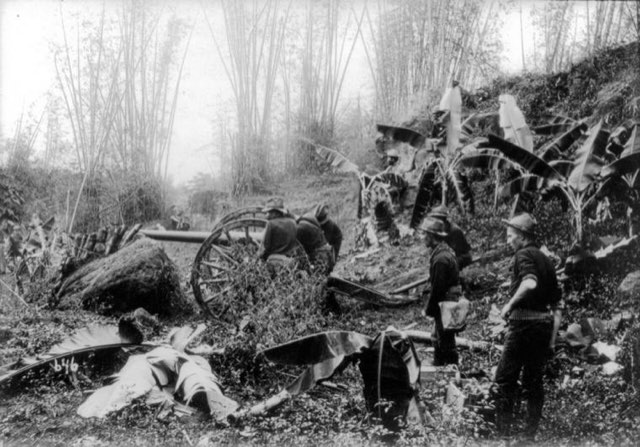
Following the Civil War, the United States became more involved in international affairs, particularly in Latin and South America. American naval forces traveled across the globe, securing and protecting American trading rights in Japan, China, and other parts of Asia. In 1898, the United States took on the aging Spanish Empire and seized control of the islands of Cuba, Puerto Rico, and the Philippines. With these acquisitions, America obtained strategic bases from which it could extend its military influence across the Caribbean and the Pacific. Some Americans objected to this growing imperial power. Following the Spanish-American War, numerous anti-imperialist groups organized protest campaigns. While these campaigns had little impact on American military and political affairs, they reflected deep-seated tensions within American society about America’s founding principles and global mission.

Gunboat Diplomacy
- Progressive EraWikibooks · US History · read
- Age of Invention and Gilded AgeWikibooks · US History · read
Expeditions in the Pacific
- When We Landed in Japan, 1854Fordham University’s Modern History Sourcebook · Paul Halsall’s version of Commodore Matthew Perry · read
American Expansionism
- The Emergence of The United States as a Global PowerTheriskyshift.com · Pavlos Efthymiou · read
Dollar Diplomacy in Latin America
- Panama CanalPBS · The American Experience · watch · archived copy
Chapter VI
The First World War
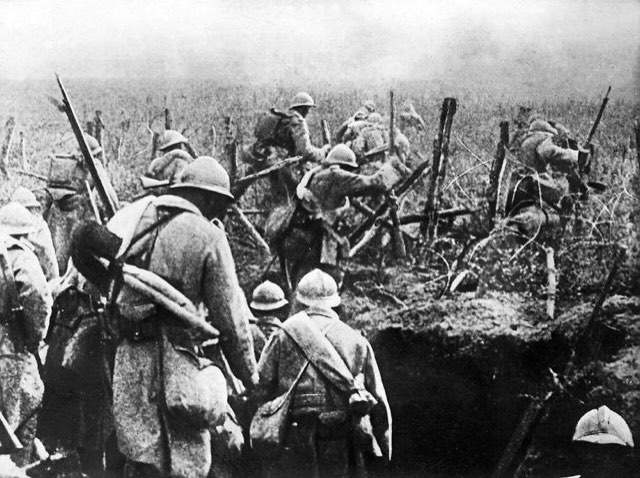
Despite America’s growing involvement in world affairs in the early 20thcentury, the American people continued to be wary of political or economic alliances with European nations. These concerns were justified by the outbreak of World War I in 1914. Separated from Europe by three thousand miles of ocean, Americans hoped to remain isolated from the deadly conflict. American President Woodrow Wilson supported American neutrality, but eventually changed his mind in 1917, following German attacks on American passenger and cargo vessels. Wilson then argued that American military forces could turn the tide of the struggle, which would allow the United States to play an important role in the post-war settlement. Many Americans supported the war effort, but a vocal minority objected to the conflict for various reasons. Wilson used the coercive power of the federal government to arrest and imprison numerous protestors. In this unit, we will examine how American forces fought on the Western Front and the lessons they learned from bloody struggle. We will also focus on the American home front during the war and study the ways in which the conflict led to new economic and social opportunities for women and minorities. Finally, we will examine how the war led to American disenchantment with military affairs and a period of renewed isolation from world politics.

Wilson’s Objectives
- Life Portrait of Woodrow WilsonC-SPAN · American Presidents · watch · no longer online
American Opposition to War
- A Message From the Religious Society of Friends in America March 1917The Quaker Peace Page · Friends National Peace Committee · read · archived copy
Chapter VII
The Second World War
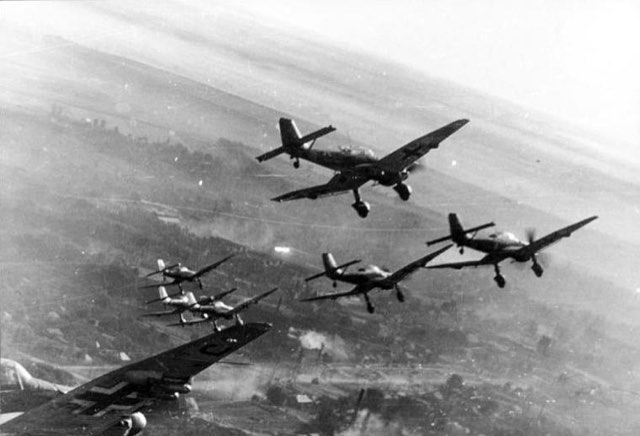
As war broke out in Europe at the end of the 1930s, America once again attempted to remain neutral. Unofficially, President Franklin D. Roosevelt wanted to support Great Britain against Nazi Germany, but public sentiment was against American involvement in the conflict. Instead, Roosevelt used indirect means to support Britain, lending the nation badly-needed naval destroyers in exchange for American access to British bases in the Atlantic. America finally entered the war in late 1941 following the Japanese attack on Pearl Harbor. Over the next four years, the nation sustained combat operations in both the Pacific and European theatres of conflict. This required a massive civilian and industrial commitment on the home front. In this unit, we will examine the major strategies that the U.S. employed in World War II and take a look at how the conflict affected Americans at home. We will also examine the cultural legacy of the war and discuss why, in hindsight, many Americans viewed the conflict as the “Good War.”

Mobilizing the Civilian Population
- A Call For Sacrifice April 28, 1942Fordham University’s Modern History Sourcebook · Paul Halsall’s version of Franklin D. Roosevelt · read
Chapter VIII
The Cold War
At the end of the Second World War, the democratic United States and the Communist Soviet Union emerged as the world’s major economic, political, and military superpowers. Both nations felt threatened by the existence of the other and attempted to secure military alliances across the globe. The U.S.’s and, later, the Soviet Union’s acquisition of nuclear weapons made the conflict even more threatening. Since neither side could attack the other directly, both pursued their political agendas through proxy wars. The Cold War had a profound impact on American society as well. Fears of Communist infiltration led to Communist “purges” in the American government and academia. Political dissent was viewed as disloyalty. The constant need for new and advanced weapons and defense systems led to a powerful relationship between the military, American industry, and the American university system. This military-industrial-academic complex held considerable influence over elected officials and played a dominant role in shaping the post-war economy.
Origins of the Cold War
- The Lost Peace and The Fifty Year WarC-SPAN and Borders Books and Music Bookstore · watch
Ideological Tensions
- CommunismKhan Academy · watch
Nuclear Arms Race
The Korean Conflict
- Korean WarWikipedia · read
- Korean War OverviewKhan Academy · watch
The Cuban Missile Crisis
- Kennedy and CrisesYouTube · Media Rich Learning’s The Cold War · watch · no longer online
- Cuban Missile CrisisWikipedia · read
- Cuban Missile CrisisKhan Academy · watch · 30 min
The Bay of Pigs
- Bay of PigsWikipedia · read
- Bay of Pigs InvasionKhan Academy · watch
What We Now Know
- The Cuban Missile Crisis in RetrospectYouTube · Woodrow Wilson School at Princeton University · Theodore C. Sorensen, Stanley N. Katz, Sheldon M. Stern, and Julian E. Zelizer · watch
The Cold War in the Developing World
- Contemporary International Politics II: Lecture 10 – The Cold War in IndochinaKeio University · Kanji Akagi · read · no longer online
Chapter IX
Vietnam
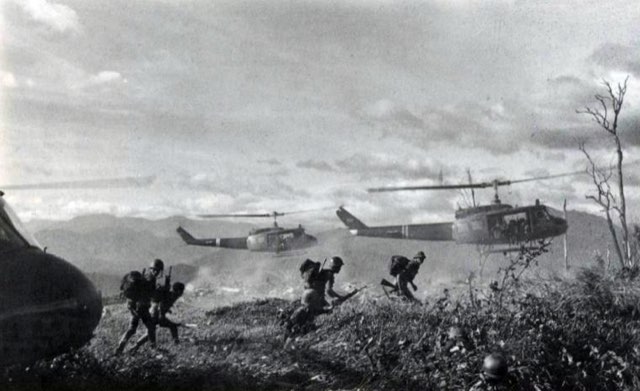
The Vietnam conflict grew out of America’s Cold War commitment to limiting the global spread of Communism. After Vietnamese national liberation forces defeated French colonial troops in the mid-1950s, the state was partitioned into Communist and democratic regions. After Communist guerilla forces in South Vietnam began to threaten the government in the early 1960s, the United States sent military advisors to the region to help South Vietnamese forces defeat the Communists. This initial commitment of ground troops expanded into a full-scale military campaign by 1964. Over the next seven years, United States military forces fought battle after battle against South Vietnamese guerillas and North Vietnamese regular army troops. Public opinion in the United States initially favored American involvement, but a vocal anti-war movement gradually swung opinion against the war by the late 1960s. American forces were eventually withdrawn from Vietnam, but not before the war took a heavy toll on U.S. military strength and American confidence. In this unit, we will examine how the United States became involved in Vietnam and look at how American strategy changed over the course of the conflict. We will also explore how the fringe anti-war movement gradually gained social acceptance and political influence during the conflict. Finally, we will look at how the Vietnam conflict had a lasting impact on American politics and military strategy.

America in South Vietnam
- Vietnam WarKhan Academy · watch · 30 min
- IndochinaYouTube · Media Rich Learning’s Vietnam · watch · archived copy
The Movement Goes Mainstream
- Vietnam Veterans against the War Statement April 23, 1971Fordham University’s Modern History Sourcebook · Paul Halsall’s version of John Kerry · read
Chapter X
The End of the Cold War
Following a decade of détente and diplomatic engagement with the Soviet Union, the United States assumed a more confrontational attitude towards the Communist regime in the 1980s. This new attitude came in response to Soviet military aggression in Afghanistan and other parts of the world. The U.S. began a large rearmament program centered on the Strategic Defense Initiative, or “Star Wars,” a space-based system of satellites that could destroy nuclear missiles and prevent Soviet attacks on the U.S. While many of these advanced military systems never moved beyond the testing stage, Soviet efforts to counter new American military technologies eventually bankrupted the regime and hastened its fall at the end of the 1980s. With the collapse of the Soviet Union, the U.S. had to realign its national defense objectives. During the 1990s, the nation began to downsize its regular military forces while increasing its commitments to peacekeeping missions across the world. In this unit, we will examine how the end of the Cold War changed American political and social expectations about the role that the American military should play in international affairs. We will also look at the regional conflicts in which U.S. military forces engaged in the 1990s, including the Gulf War and peacekeeping missions in Somalia and the former Yugoslavian republics, exploring the ways in which these wars affected American society and politics.
Reagan and the New Strategy of Global Engagement Against Communism
- Ronald ReaganPBS Video · The American Presidents · watch · archived copy
Collapse of the Soviet Union
- The End of the Cold WarThe Gilder Lehrman Institute of American History · Thomas Blanton · watch
Post-Cold War Military Conflict: The Persian Gulf War
- Bush & ClintonWikibooks · US History · read
- George H.W. BushPBS Video · The American Presidents · watch · archived copy
- Desert Shield and the Gulf WarC-SPAN · watch · no longer online
Chapter XI
The Global War on Terror and the New World Order
During the first decade of the 21st century, the threat of militant Islamic terrorist organizations across the globe has largely dictated America’s military commitments. Following the 9-11 attacks, American military forces engaged in two major conflicts in Afghanistan and Iraq. The Iraq invasion came as part of President George W. Bush’s doctrine of preemptive war, designed to eliminate threats to American national security. While American forces enjoyed great success in their military objectives, they encountered great difficulties maintaining the post-war peace and rebuilding local and national infrastructures in Iraq and Afghanistan. These wars also generated serious doubt as to whether America can combat terrorism without compromising her fundamental political and social values. In this final unit, we will examine the challenges currently facing American military forces and look at how a decade of conflict has reshaped American social and political expectations regarding the role that the military should play in international affairs. Finally, we will look beyond the first decade of the 21st century and consider future challenges that the American military may face and how these challenges will affect American society.
The War on Terror
- War on TerrorThe Saylor Foundation · read
9-11 and the New Global Conflict
- September 11 AttacksThe Saylor Foundation · read
The War in Afghanistan
- War in Afghanistan (2001-Present)Wikipedia · read
The Iraq War
- Invasion of IraqThe Saylor Foundation · read
About this course
This course is Saylor Academy's HIST313, War and American Society, one of the complete university courses the Saylor Foundation made free from 2008 and retired in 2015. Saylor licensed its course text under CC BY 3.0; the original is on GitHub. Here it is laid out as chapters, links that have died go to an archived copy from the Internet Archive where one exists, assessments that needed a Saylor login are left out, and people and works are linked to Kulturbase. The readings and lectures belong to their publishers and are linked, not copied. Pictures: Wikimedia Commons, credited under each picture.
All Saylor courses · Free culture courses · The Chautauqua Reading Course