History · Saylor HIST351
Islam, The Middle East, and The West
This course will introduce you to the history of the Middle East from the rise of Islam to the twenty-first century. The course will emphasize the encounters and exchanges between the Islamic world and the West.
More about this course
It will be structured chronologically—each unit will focus on the emergence of a particular Middle Eastern society or empire during a specific time period. Each unit will include representative primary-source documents that illustrate important overarching political, economic, and social themes, such as the emergence of Islam in the seventh century, conflicts between Islamic and Christian peoples during the Crusades, European domination of Muslim territories in the nineteenth century, independence movements and the rise of nationalism in the 1900s, and the formation of Islamic fundamentalist groups and anti-Western sentiment in the latter twentieth century. By the end of the course, you will understand how Islam became a sophisticated and far-reaching civilization and how conflicts with the West shaped the development of the Middle East from the medieval period to the present day.
Upon successful completion of this course, students will be able to:
In order to take this course you must: √ Have access to a computer. √ Have continuous broadband Internet access. √ Have the ability/permission to install plug-ins or software (e.g., Adobe Reader or Flash). √ Have the ability to download and save files and documents to a computer. √ Have the ability to open Microsoft files and documents (.doc, .ppt, .xls, etc.). √ Be competent in the English language. √ Have read the Saylor Student Handbook.
Chapter I
Islamic Civilization
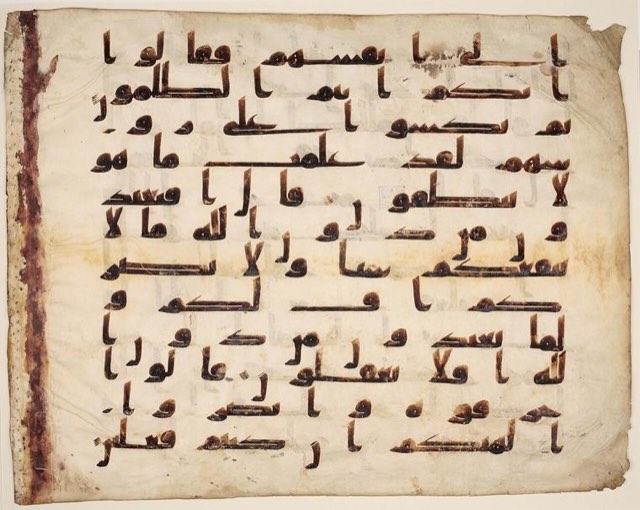
Islam first arrived on the Arabian Peninsula in the seventh century. But before its appearance, the tribal societies living on the Arabian Peninsula—the Bedouin—embraced polytheistic or animistic religious beliefs. Bedouin clans, the nomadic societies built around goat and camel herding, populated the desert. Towns and cities, including Mecca, were dependent upon alliances with the neighboring Bedouin tribes. When Muhammad began preaching his “revelations” in the 600s, he encountered hostility and criticism from many Arab communities. However, the Bedouin eventually became enthusiastic converts to Islam—a universalizing faith that united disparate Arab tribes. In this unit, we will study the culture and religion of the Bedouin tribes of Arabia. We will then examine the effects that Muhammad’s conversion efforts had among the Bedouin in the seventh century.

Pre-Islamic Arabia
- Pre-Islamic ArabiaWikipedia · read
Bedouin Nomads
Origins of Islam
- The Life of the Prophet, The Spread of IslamUniversity of Notre Dame · read · archived copy
- MuhammadPBS’s Islam · Empire of Faith · watch
Chapter II
Islamic Society and Faith
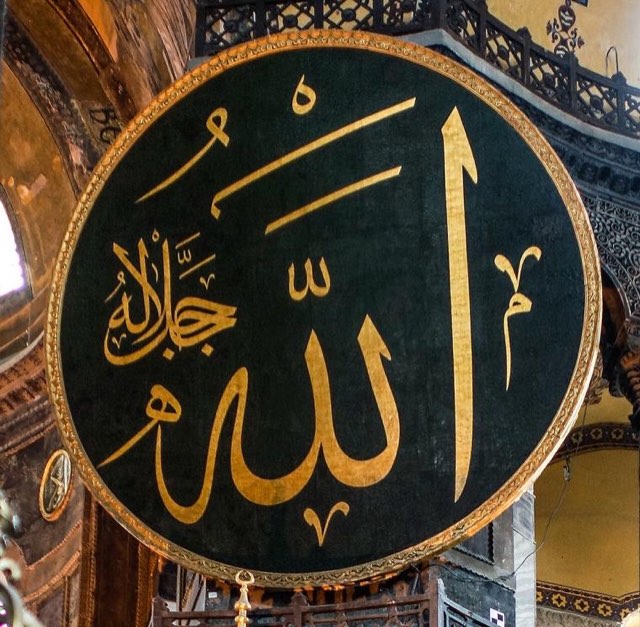
Islam became an established religion in the Middle East after the death of the Prophet Muhammad in 632 C.E. Although Muhammad originally worked as a merchant in Mecca, he soon became disenchanted with society and retreated to a cave for meditation. It was there, at the age of 40, that Muhammad began to receive his first revelations from God. These revelations formed the basis of the Qur’an—the main religious text on which the Islamic faith is based. Muhammad began preaching his revelations to the tribes of the Arabian Peninsula; although he met with initial hostility, many of the tribes had converted to Islam by the time of Muhammad’s death. His successors—the “four rightly guided caliphs”—continued conversion efforts during the Umayyad dynasty. Muslims consider Muhammad’s revelations to be the true word of God (Allah). These revelations form the basis of Islamic law, religious practices, and philosophy.
In the Great Books lists Qur’an

The Qur’an
- The Qur’anWashington State University · Richard Hooker, et al’s World Civilizations · Islam · read · archived copy
Religious Practices
- Five Pillars of IslamWikipedia · read
The Qur’an
- The Qur’an (Selections)Washington State University · Richard Hooker, et al’s World Civilizations · Islam · read · archived copy
Fiqh and Sharia
- Fiqh and ShariaWikipedia · read
Sufism
- What is Sufism?iTunesU · The Open University · Islam in the West, Lecture 9 · watch · archived copy
Society and Culture
- Introduction, The Arts, and Islam and Knowledge.The University of Calgary · The Applied History Research Group’s The Islamic World to 1600 · The Arts, Learning, and Knowledge · read · archived copy
Chapter III
Arab Conquests and the Rise of the Caliphate
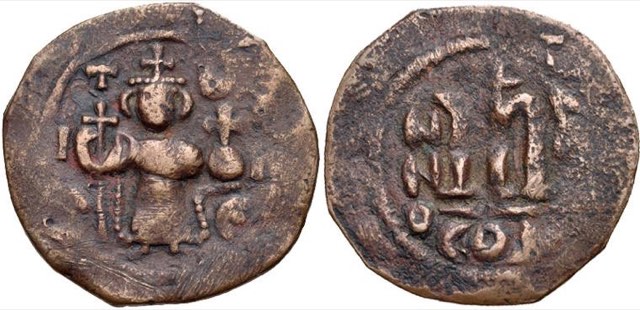
After being united under the aegis of Islam, the Arabs—known as the Umayyads—began military campaigns outside of their realm. In the mid-seventh century, Muslim armies began invading parts of the increasingly vulnerable Sassanid and Byzantine empires, claiming land in what is now Egypt, Syria, and Palestine. In fact, so powerful were the Islamic army and navy that Byzantium was permanently crippled by the invasions. The Umayyads went on to conquer northern Africa and invade India, building a kingdom that exceeded the size of the Roman Empire. But despite their success abroad, the Umayyads suffered a period of discord at home: a succession dispute resulted in a division of Muslims into Sunni and Shi’a factions. While the Sunnis retained temporary control of the caliphate, a Shi’ite uprising in 750 C.E. toppled the Umayyads and established Abbasid rule. Under the Abbasids, mass conversion to Islam was encouraged, as was a dynamic Afro-Eurasian trade network. The Abbasids also established Persian as the official language, and encouraged the flowering of Islamic culture. In this unit, we will study how the unity of the Arab world under Islam allowed for the expansion of the Umayyad Empire in the 600s. We will also consider the causes for the Sunni-Shi’a split and the emergence of the Abbasid dynasty.

The Rise of the Umayyads
- Medieval Period of ExpansionUniversity of Notre Dame · read · archived copy
Internal Divisions: the Sunni-Shi’a Spilt
- The Influence of the Shi’a on IslamUniversity of Notre Dame · read · archived copy
- Sunni/Shi’a ConflictiTunesU · University of Wisconsin–Madison & Wisconsin Public Radio · watch · archived copy
Expansion into India and the Mediterranean
- Expansion into India and the MediterraneanThe Saylor Foundation · read
Non-Muslim Peoples
- Non-Muslim PeoplesThe Saylor Foundation · read
The Abbasids
- Medieval Sourcebook: Yakut: Baghdad under the Abbasids, c. 1000 CEFordham University · Paul Halsall · read
- Lecture 16 - The Splendor of the Abbasid PeriodOpen Yale Courses · Paul Freedman · watch · archived copy
- Introduction, The Abbasid Dynasty, Spain and the Maghrib, Egypt, West Africa, Central Asia, Southeast Asia, China, Chapter Summary.The University of Calgary · The Applied History Research Group’s The Islamic World to 1600 · Fractured Caliphate and the Regional Dynasties · read · archived copy
Chapter IV
The Expansion of Islam into Europe
When a Shi’a leader—Abu al-Abbas—usurped power from the reigning Sunni caliph in 750 C.E., the Umayyad era officially came to a close. While al-Abbas tried to execute all members of the Sunni Umayyads, one leader escaped to the Iberian Peninsula, where he established a new Umayyad kingdom. However, Abd ar-Rahman I was not the first Muslim to invade Spain; Muslim Berbers had overthrown the Visigoths and established the kingdom of Al-Andalus in the early eighth century. Still, the Umayyads in Spain—known as the Caliphate of Cordoba—retained power until the 1000s. With the decline of the Caliphate, several smaller kingdoms, called “taifas,” claimed control over southern Spain. It was not until 1492, when the Christian monarchs Ferdinand and Isabella declared a holy war against the Spanish Muslims did Muslim control of the region come to an end. In this unit, we will study the emergence of a new Umayyad imperium in southern Spain in the 700s. We will also examine the decline of the Umayyad caliphate and the rise of independent Berber kingdoms that became locked in conflict with Christian Spain.
The Iberian Peninsula
- Islam in SpainWikipedia · read
- Al-AndaulusWikipedia · read
The Berber Dynasty
- The Berber DynastyThe Saylor Foundation · read
Taifas
- Poetry of the Spanish Moors, SelectionsFordham University · Paul Halsall’s The Medieval Sourcebook · read
Chapter V
The Crusades
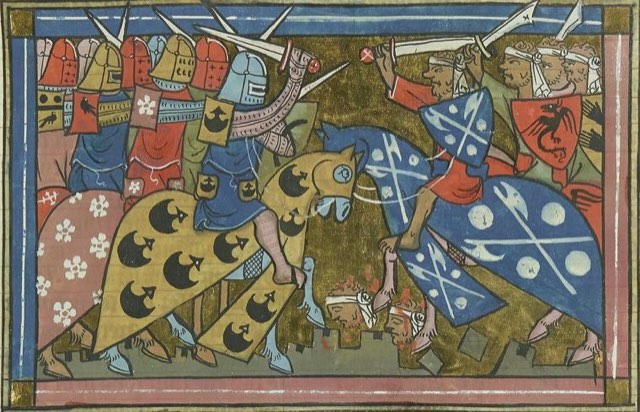
The Crusades—a series of religious wars launched to restore Christian control of the Holy Land—began in 1096 and were the most conspicuous sign of the rise and expansion of Christian Europe. The first crusade resulted in the division of Syria and Palestine into smaller Christian kingdoms, although subsequent crusades had less successful outcomes. Under the Muslim ruler Saladin, most of the Holy Land was reclaimed for Islam by the late 1100s; by 1251, Muslim armies had expelled all Christian kingdoms. The impact of the Crusades was twofold: first, they established a precedent for the rift between Western Christendom and the Middle Eastern Muslim world and second, they intensified commercial contact between the two regions. While Europeans were interested in obtaining textiles, scientific knowledge, and medicine from the Muslim world, Muslims had little interest in European goods or culture. In this unit, we will examine the causes and effects of the European claim to the Muslim-dominated Holy Land. We will also study the impact of the Crusades, which led to the fall of Byzantium and increased anti-Muslim sentiment in Christian Europe.

Recapturing Jerusalem from Muslim Control
- Fulk of Chartres: ‘The Capture of Jerusalem, 1099Fordham University · Paul Halsall’s The Medieval Sourcebook · read
Chapter VI
The Ottomans and the Safavids
Two powerful Muslim empires emerged in the Middle East in the thirteenth and fourteenth centuries. The Ottomans ruled Asia Minor, eastern Europe, northern Africa, and parts of the Middle East, while the Safavids built an empire that included present-day Afghanistan and Iran. Both, however, possessed a religious zeal for the expansion of Islam. The Ottomans emerged in the wake of Mongol defeat: they invaded the Balkans, captured Constantinople, and toppled Byzantium, forging a military state ruled by a sultanate and dominated by a warrior aristocracy. The Safavids also rose to power in the wake of the Mongol invasions. The Safavids were Shi’a Muslims who claimed leadership and established rule by a shah and his court. Both the Ottomans and the Safavids encouraged Islamic learning and cultural advancement while also bolstering trade.
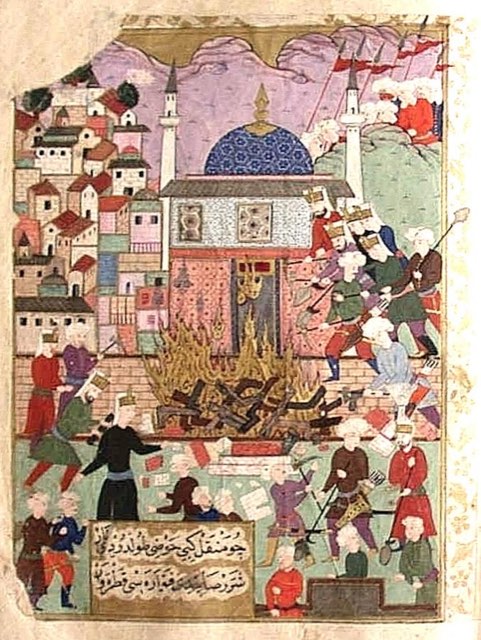

The Safavids
- Safavid DynastyWikipedia · read
Chapter VII
European Challenges and the Ottoman Empire
By the nineteenth century, the Ottoman Empire was in decline. The Ottomans, their imperial holdings much reduced since their heyday in the sixteenth century, became increasingly dependent on European resources to buoy their empire. Beginning in the late 1800s, Ottoman leaders embarked upon a policy of reform that they believed would modernize their state by implementing constitutional government, educational systems, new technology, and new industry with European monies. As a result of this financial dependence, many European powers began to dominate or annex Ottoman holdings in the Middle East in the 1800s. With the outbreak of World War I in 1914, the Ottomans allied themselves with the Central Powers—Austria-Hungary and Germany—but were defeated by the Allied forces in 1918. In this unit, we will study the reasons for the decline of the Ottoman Empire in the nineteenth and twentieth centuries. We will also examine how and why European nations challenged Ottoman authority and began to exert power in the Middle East.
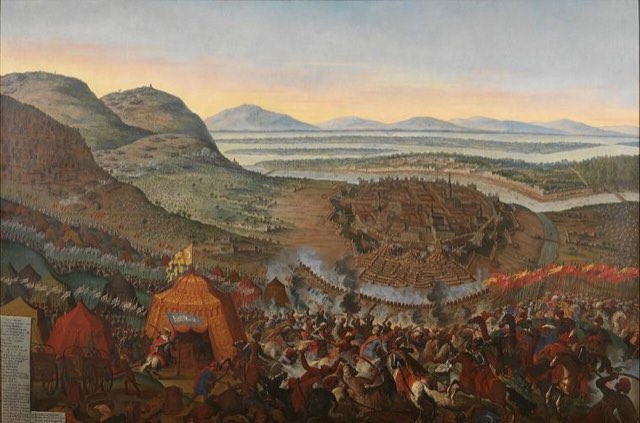

Ottoman Empire in the 1800s
- Ottoman EmpireWikipedia · read
European Dominion of the Ottoman Empire
- The Middle East and the West: Carving Up the RegionNPR · Mike Schuster · watch
The Young Turks
- Young TurksWikipedia · read
- The Young Turks: Proclamation for the Ottoman Empire, 1908.Fordham University · Paul Halsall’s Modern History Sourcebook · read
Chapter VIII
The Islamic World in an Age of European Domination
The collapse of the Ottoman Empire, the end of World War I, and the discovery of oil allowed European powers to gain new influence in the Middle East. Near the end of World War I, Britain and France negotiated for the partition of the Middle East between them, proclaiming territorial “mandates.” In addition, Britain promised European Zionists a Jewish homeland in Palestine. Not only were Britain and France interested in expanding their influence in the Middle East, but they were keen on exploiting the Middle East’s primary resource: oil. Oil fueled the development of industrial Europe, and by mandating control over Middle Eastern countries, Britain and France were guaranteed access to sought-after petroleum products. In this unit, we will consider the how and why territorial mandates and protectorates under the authority of European powers were established in the Middle East. We will also study how these policies ignited conflict among Islamic peoples, especially in Palestine.
The Arab Revolt
- Arab RevoltWikipedia · read
Rise of Kemal Ataturk and the Europeanization of Turkey
- Mustafa Kemal AtaturkWikipedia · read
Partitioning the Middle East
- The Time Between Wars and Palestine and ZionismiTunesU · Columbia University · Richard Bulliet’s W3719 History of the Modern Middle East, Lectures 16 & 17 · watch · archived copy
The Sykes-Picot Agreement
- Sykes-Picot AgreementWikipedia · read
- Sykes-Picot AgreementWWI Document Archive · read
The Balfour Declaration
- The Balfour Declaration and the British MandateNPR · Mike Shuster’s The Mideast · A Century of Conflict · watch · archived copy
British Mandated Territories
- British Mandate TerritoriesWikipedia · watch

French Mandated Territories
- French Mandate TerritoriesWikipedia · watch

Discovery of Oil
- The Black GiantPBS’s The Prize · watch · archived copy
Chapter IX
Nationalism and Independence Movements
Beginning in 1940s, Britain and France abandoned their protectorates and ended their mandates in the Middle East, largely due to conflicts that erupted between local governments and their foreign occupiers. Between 1941 and 1947, Iran, Lebanon, Syria, Jordan, Iraq, and Egypt (with the exception of the British-dominated Suez Canal) became independent of European rule. And in 1948, Zionists established the state of Israel, a declaration that precipitated the 1948 Arab-Israeli war and decades of subsequent conflict. However, while many Middle Eastern nations became independent of British and French rule in the 1940s, the onset of the Cold War attracted new foreign interest in the region. As a result, the United States and the Soviet Union vied for control of the Middle East throughout much of the twentieth century.
Revolts Against European Domination
- The Question of Islamic Authority and New Muslim OrganizationiTunesU · Columbia University · Richard Bulliet’s W3719 History of the Modern Middle East, Lectures 18 & 19 · watch · archived copy
World War II
- War and OilPBS’s The Prize · watch · archived copy
The Suez Canal
- Suez CrisisWikipedia · read
The Anglo-Iraqi War
- Anglo-Iraqi WarWikipedia · read
The Allied Invasion of Syria-Lebanon
- The Allied Invasion of Syria-LebanonThe Saylor Foundation · read
The Anglo-Soviet Invasion of Iran
- Anglo-Soviet Invasion of IranWikipedia · read
The Cold War in the Middle East
- The Middle East and the West: The U.S. Role GrowsNPR · Mike Shuster · watch
- Sowing CrisisNPR · Columbia University · Rashid Khalidi · watch
- The Cold WariTunesU · Columbia University · Richard Bulliet’s W3719 History of the Modern Middle East, Lecture 20 · watch · archived copy
- Lippman’s ‘Mirage’ Tracks History of U.S.-Saudi TiesCouncil on Foreign Relations/ NPR · Thomas W. Lippman · watch
- Crude DiplomacyPBS’s The Prize · watch · archived copy
Egypt and the First Revolution
- Egyptian Revolution of 1919Wikipedia · read
Syria and the Battle of Maysalun
- Syria and the Battle of MaysalunThe Saylor Foundation · read
Iraqi Revolt Against the British
- Iraqi Revolt Against the BritishWikipedia · read
Arab Nationalism vs. Zionism
- Eisenhower DoctrineWikipedia · read
- The Eisenhower Doctrine on the Middle EastFordham University · Paul Halsall’s Modern History Sourcebook · read
Iran
- Iran Under the ShahsiTunesU · Columbia University · Richard Bulliet’s W3719 History of the Modern Middle East, Lecture 23 · watch · archived copy
- ’New York Times’’ Correspondent Stephen KinzerNorthwestern University/NPR · Steven Kinzer · watch
Partitioning of Palestine
- Partition, War and IndependenceNPR · Mike Shuster · watch · archived copy
The Arab-Israeli War of 1948
- 1948 Arab-Israeli WarWikipedia · read
The Six Day War (June 1967)
- The 1967 Six Day WarNPR · Mike Shuster · watch · archived copy
- Israel and the 1967 WarUCTV (University of California Television) · Tom Segev · watch
- Part IINPR/American Radio Works/Minnesota Public Radio · Sandy Tolan’s The Arab World and the West · watch
- From the 1973 Yom Kippur War to Peace with EgyptNPR · Mike Schuster’s The Mideast · A Century of Conflict · watch · archived copy
- Power to the ProducersPBS’s The Prize · watch · archived copy
Chapter X
The Islamic Revolution, Terrorism, and the West
The Islamic Revolution of 1979 (also known as the Iranian Revolution) overthrew the reigning shah (king) and established a theocratic state. The leader of the revolt, a Shi’ite Muslim cleric, proclaimed himself Ayatollah—or “supreme leader”—of Iran. The Ayatollah asserted the importance of the Islamic faith and decried Western influence and policy. The revolution established an important precedent in the Middle East by encouraging the proliferation of an Islamic ideology throughout the region. As a result, in the 1980s and 1990s, many fundamentalist Muslim groups emerged, including Al Qaeda and the Taliban. Many of these groups embraced an extreme strain of Islam as well as violent anti-Western sentiment. Islamic fundamentalists were responsible for numerous terrorist attacks against Western powers, including the 1998 embassy bombings in Africa and the September 11, 2001 attacks in New York City.
The Islamic Revolution of 1979
- Three Decades of the Islamic Republic of IranColumbia University SIPA (School of International and Public Affairs) · Richard Bulliet · watch
- Thirty Years of Islamic RevolutionColumbia University · Leiden University · Asef Bayet · watch
Overthrow of Iran’s Monarchy
- Ayatollah Ruhollah Khomeini: The Uprising of Khurdad 15, 1979Fordham University · Paul Halsall’s Modern History Sourcebook · read
Islamic Fundamentalism
- Islamic FundamentalismThe Saylor Foundation · read
The Iran-Iraq War
- Iran-Iraq WarWikipedia · read
The Israeli-Palestinian Conflict Since 1980
- From the First Intifada to the Oslo Peace AgreementNPR · Mike Shuster · watch · archived copy
- The Second Intifada and the Death of OsloNPR · Mike Shuster · watch · archived copy
Hezbollah
- Who is Hezbollah?NPR · Neal Conan · watch · archived copy
Al Qaeda
- The Rise of al-QaedaUCTV (University of California Television) · Steve Coll · watch
The Taliban
- TalibanWikipedia · read
September 11 Attacks
- September 11 AttacksThe Saylor Foundation · read
“War on Terror”
- War on TerrorThe Saylor Foundation · read
Invasion of Iraq
- Invasion of IraqThe Saylor Foundation · read
War in Afghanistan
- War in Afghanistan (2001-Present)Wikipedia · read
About this course
This course is Saylor Academy's HIST351, Islam, The Middle East, and The West, one of the complete university courses the Saylor Foundation made free from 2008 and retired in 2015. Saylor licensed its course text under CC BY 3.0; the original is on GitHub. Here it is laid out as chapters, links that have died go to an archived copy from the Internet Archive where one exists, assessments that needed a Saylor login are left out, and people and works are linked to Kulturbase. The readings and lectures belong to their publishers and are linked, not copied. Pictures: Wikimedia Commons, credited under each picture.
All Saylor courses · Free culture courses · The Chautauqua Reading Course